
For most people, turning on the faucet to wash their face or brush their teeth is simply part of the morning routine. However, one detail is easy to overlook: after remaining unused overnight or for an extended period, the water inside the faucet and its internal waterways has also been sitting still for a long time. Water that remains stagnant inside a faucet for an extended period is different from water that is continuously flowing and being renewed. This is particularly relevant in handwashing facilities such as public restrooms, healthcare facilities, schools, and offices, where faucets may remain unused throughout the night or during non-operating hours. Reducing prolonged water stagnation inside the internal waterways is therefore another aspect worth considering. So, what actually happens to the water inside a faucet when it has not been used overnight?
When a faucet is not used for an extended period, the water inside its internal waterways is no longer continuously renewed and remains relatively stagnant. As the stagnation period increases, several factors are worth considering.
During normal use, flowing water carries out the water that has been sitting inside the waterways while bringing new water into the internal flow path. When a faucet remains unused for a long time, however, this water is no longer being renewed. Faucets with longer or more complex internal waterways may be more likely to have water remain inside for extended periods. In other words, when the faucet stops being used, the water inside its waterways also stops flowing.
Water is not necessarily free of microorganisms. When water remains stagnant for an extended period, factors such as ambient temperature, internal conditions within the waterways, and other variables may increase the opportunity for microbial growth. Therefore, in public handwashing environments where hygiene management is particularly important, reducing prolonged water stagnation inside the faucet's internal waterways is another detail worth considering.
People often focus on the water source before it enters a building, but may overlook what happens after the water enters the faucet.
A faucet is not simply an outlet. It typically contains an inlet passage, valve body, and other internal waterway structures. When the faucet remains unused for an extended period, the water inside these pathways cannot be renewed promptly. Therefore, in addition to considering the water source itself, it is also important to consider how long water remains inside the faucet after entering the device.
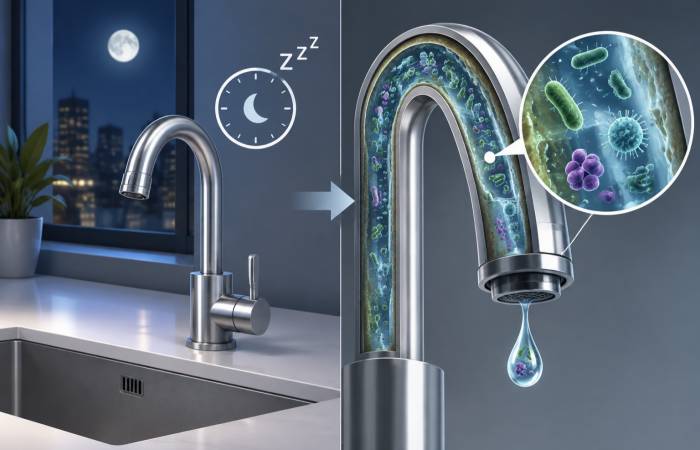
For conventional faucets, waterway renewal generally depends on the user actively using the faucet. In other words, once the faucet stops being used, the water inside its internal waterways remains stagnant until someone turns the faucet on again. New water then enters the system and gradually flushes out the water that has been sitting inside.
For faucets that are used frequently, this may not be particularly noticeable. However, the situation can be different in environments such as:
l Long periods of non-use overnight
l Reduced usage during weekends or holidays
l Office areas that are not in operation outside working hours
l Public facilities that may remain unused for extended periods
Under these conditions, the water inside the faucet may remain without renewal for a prolonged period. More importantly, users cannot be expected to remember to turn on every faucet each day simply to flush the internal waterways. This is an easily overlooked limitation of conventional faucets: without an active waterway flushing mechanism, renewal of the water inside the waterways mainly depends on the next time someone uses the faucet.
To address the potential for prolonged water stagnation when a faucet remains unused, Bestware has incorporated an automatic periodic flushing function into its sensor faucet series. When the faucet has not been used continuously for 24 hours, the system automatically activates the water flow for approximately 5 seconds, providing a short flush of the internal waterways. This brief flow allows the water that has remained stagnant inside the waterways for an extended period to be discharged and renewed. The process requires no user intervention. Staff do not need to manually turn on the faucet every day, nor do they need to follow additional complicated operating procedures. Once the faucet reaches the preset period of non-use, the Bestware sensor faucet automatically performs a short waterway flush.
The automatic flushing process can be summarized as:
24 hours without use → water flow activates automatically → approximately 5 seconds → internal waterway renewal
The purpose of this design is not to add more complicated functions, but to shift waterway renewal, to some extent, from being dependent on user operation to being actively initiated by the faucet.
Five seconds may not seem like a long time. However, the purpose of this function is not to run the water for an extended period. Instead, it uses a brief, periodic flow to reduce the amount of time water inside the internal waterways remains completely stagnant.
No. | Aspect | Conventional Faucet | Bestware Sensor Faucet Series |
1 | When unused for an extended period | Water remains stagnant inside the waterways | Automatic flushing every 24 hours |
2 | Waterway renewal | Mainly depends on active user operation | Water flow is triggered automatically |
3 | Manual operation required | The faucet needs to be turned on manually | No additional operation required |
4 | Management of prolonged water stagnation | No active renewal mechanism | Periodic short-duration flushing |
5 | Waterway management | Depends on everyday usage frequency | Adds an automatic waterway renewal mechanism |
The key difference between the two is not how water is dispensed, but how the internal waterways are managed when the faucet remains unused for an extended period. A conventional faucet generally remains passive—the waterways are renewed only when someone uses the faucet. The Bestware sensor faucet series, by contrast, adds an automatic periodic flushing mechanism that performs a short flush after 24 consecutive hours without use.
It is important to clarify that periodic automatic flushing is not the same as disinfecting the waterways, nor does it replace routine equipment maintenance and hygiene management. Its primary purpose is to:
Use periodic, short-duration water flow to reduce prolonged stagnation inside the internal waterways and promote water renewal within the system.
This function should therefore be understood as an active waterway management feature rather than a disinfection function. Routine equipment maintenance, water quality management, and other hygiene measures remain important.
When choosing sensor faucets for handwashing facilities, people typically focus on functions such as:
l Sensor responsiveness
l Touchless operation
l Stable water flow
l Compatibility with the installation environment
But there is another question that is rarely considered: What happens to the water inside the internal waterways when nobody uses the faucet for an extended period? This is the issue addressed by the automatic periodic flushing function. In addition to its standard sensor-activated water flow, the Bestware sensor faucet series incorporates a 24-hour automatic flushing mechanism. When the faucet has not been used continuously for 24 hours, the system automatically activates the water flow for approximately 5 seconds, providing a short flush of the internal waterways. Users do not need to remember when to operate the faucet, and staff do not need to manually run the water. The faucet uses an automated process to complete a periodic waterway renewal. For public handwashing facilities that remain unused overnight, experience lower usage during holidays, or may be left idle for extended periods, this design provides a more proactive approach to waterway management.
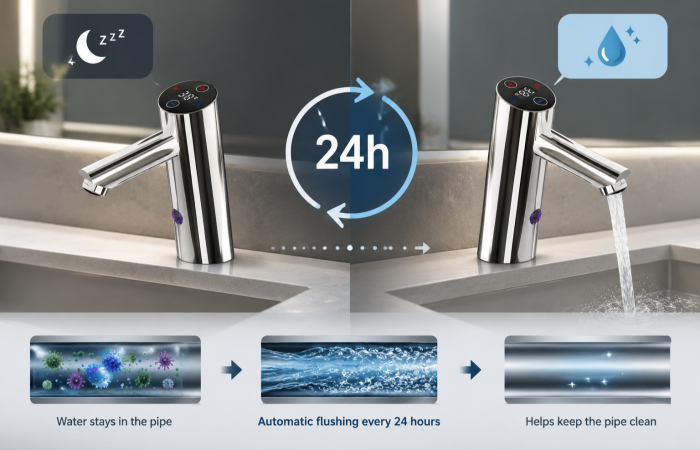
When a faucet remains unused for a long time, people tend to focus only on the fact that “nobody is using it,” while overlooking the fact that the water inside its internal waterways is also remaining stagnant. Conventional faucets generally rely on the next user operation to renew the water inside the waterways. Bestware, however, incorporates an automatic periodic flushing function into its sensor faucet series. When the faucet has not been used continuously for 24 hours, it automatically activates approximately 5 seconds of water flow to provide a short flush of the internal waterways, helping reduce prolonged water stagnation and promote periodic water renewal. This function is not a disinfection feature and cannot replace routine equipment maintenance. Instead, it provides a form of active waterway management that is easy to overlook. Rather than relying entirely on when someone happens to turn on the faucet, the system automatically performs a waterway flush after a prolonged period of non-use. A design that takes only about five seconds addresses a question that conventional faucets can easily leave unanswered: When nobody is using the faucet, should the water inside its internal waterways also be renewed periodically?