
In high usage environments such as commercial kitchens and food processing facilities, pre rinse faucets must deliver reliable water output while enduring heavy duty, continuous operation. Thanks to its lead free composition, corrosion resistance and easy to clean surface, stainless steel has become an increasingly popular material for commercial faucets.A common question arises: although raw stainless steel generally costs less per unit weight than brass, why are finished stainless steel faucets more expensive? The answer lies far beyond raw material pricing. Final product cost is heavily shaped by casting, machining, surface finishing, capital equipment investment and production lead times once raw materials enter manufacturing facilities.
Per weight purchase prices show brass typically costs 2-3 times more than stainless steel. This simple comparison often creates a misleading assumption that stainless steel finished products should be cheaper. Faucets are machined goods, and raw material expense accounts for only a portion of total costs.Stainless steel features higher hardness and melting points. It generates substantial heat during cutting, creating greater cutting resistance and accelerated tool wear. Brass, by contrast, is relatively soft and ductile, making it well suited for high speed machining. For identical components meeting the same precision requirements, stainless steel demands longer processing cycles and tighter process controls.

Casting represents the first major difference. Brass faucets are commonly produced via reusable metal mold casting; once tooling is ready, casting cycles take roughly 2-3 days. Stainless steel mostly relies on investment casting (lost wax casting). The workflow includes wax pattern creation, ceramic shell building, drying, pouring and shell removal. Shell fabrication requires repeated slurry dipping and sand coating for approximately seven cycles, with an overall preparation lead time of around one month. Each ceramic shell is single use.Gaps persist through subsequent machining. For threading operations, brass components may finish in about 5 seconds, while equivalent stainless steel threading under matching precision standards can take over 2 minutes. Polishing is similarly impacted: stainless steel’s higher hardness creates higher resistance, yielding roughly half the throughput achievable with brass.For surface finishing, brass often undergoes bulk electroplating with reasonable tolerance for minor casting imperfections. Stainless steel workpieces normally receive brushed finishing, requiring excellent substrate flatness, plus pickling and passivation treatments to boost corrosion resistance. A single stainless steel piece needs 30-60 minutes for full surface treatment, versus merely 3-5 minutes for brass.These stacked process steps extend overall production timelines. Standard brass faucet lead times run around 15 days, whereas stainless steel production generally requires 45 days or more.

Machining stainless steel imposes demanding requirements on production hardware. High cutting temperatures and mechanical resistance call for hard grade, heat resistant cutting tools paired with robust cooling systems. Cutting parameters such as speed and feed rate need fine tuned control; improper settings cause thermal deformation, surface burning or dimensional errors.Machine tool platforms built for stainless steel rigidity and precision typically cost 1-2 times more than equipment intended for brass processing. Furthermore, stainless steel manufacturing calls for higher skilled operators. Labor and technical expertise feed directly into final product pricing.
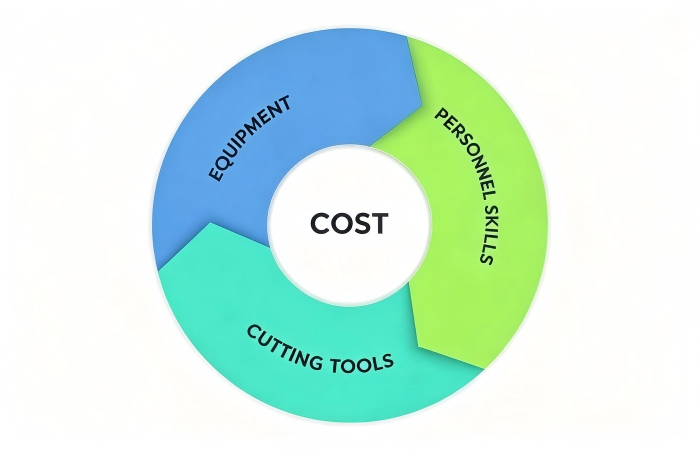
Stainless steel holds an advantage in raw material pricing. Once manufacturing workflows, capital equipment expenses, labor and lead time overhead are incorporated, however, the cost balance shifts dramatically.
No. | Material | Raw Material Cost Multiple | Raw Material Cost Share | Manufacturing Process Cost Multiple | Manufacturing Process Cost Share | Total Cost Multiple |
1 | SUS304 | 1 | 20% | 6 | 80% | 5 |
2 | Brass | 2.5 | 60% | 1 | 40% | 1.9 |

Stainless steel advantages extend past material properties alone. Total cost of ownership matters greatly for commercial deployments. Without depending on electroplated surface layers,stainless steel avoids maintenance headaches caused by peeling plating and reduces environmental burdens associated with plating operations.Its strong corrosion and wear performance lowers repair expenses stemming from leaks, sticking mechanisms and frequent component replacements. Being naturally lead free and immune to verdigris formation, stainless steel fits applications with strict hygiene and environmental expectations.Even with higher upfront manufacturing costs, buyers operating high volume commercial sites should evaluate downstream costs covering maintenance, operational downtime and component replacement across the full product lifecycle.

Higher prices for stainless steel commercial faucets do not stem from pricier raw stainless steel stock. Instead, they reflect stricter demands for casting, machining, surface finishing, production hardware and skilled labor. Raw material expense marks merely the starting point; manufacturing phase operations create most of the final price gap.For commercial buyers prioritizing stability, durability and long term value, stainless steel benefits must be assessed through the complete product lifecycle. Bestware continuously optimizes material selection, manufacturing workflows and quality control for stainless steel commercial faucets, delivering dependable fixtures for demanding foodservice environments.