
The user experience of a Pre Rinse Faucet is influenced by more than just the Spray Valve, cartridge, or water outlet design. An often-overlooked component—the hose—can also affect durability, handling, and overall performance.In commercial kitchens, a Pre rinse faucet hose is frequently stretched, bent, and exposed to water at different temperatures. This means the hose material needs to withstand frequent use, temperature changes, and continuous water pressure.EPDM is a commonly used rubber material for this type of application. So, why is EPDM suitable for Pre rinse faucet hoses? And what should you consider when choosing an EPDM hose?
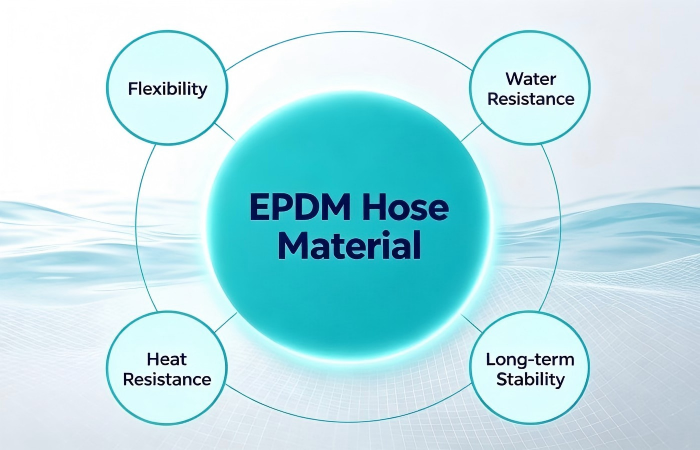
Unlike conventional hoses used in static applications, a Pre rinse faucet hose needs to bend and return to its original position as the spray valve is moved. The material therefore needs to offer not only flexibility, but also good resistance to water, heat, and aging.The main advantages of EPDM come from its material properties:
No. | Material Property | Benefit |
1 | Good water resistance | Helps prevent rapid deterioration during prolonged contact with water |
2 | Good heat resistance | Better suited to applications involving hot water |
3 | Ozone and aging resistance | Helps extend hose service life during long-term use |
4 | Good flexibility | Makes it easier to pull, bend, and move the spray valve repeatedly |
5 | Good resistance to various chemicals | Better suited to common cleaning conditions in commercial kitchens |
Some technical references indicate that certain high-grade EPDM materials can be used in drinking-water-related applications and offer good water resistance and a certain level of high-temperature performance. However, actual performance depends on the material formulation and hose construction.Therefore, the value of EPDM in a Pre rinse faucet hose is not simply that it is “softer” or “more heat-resistant.” Its advantage lies in achieving a good balance of flexibility, water resistance, heat resistance, and long-term stability.
Seeing “EPDM” on a product does not mean that all EPDM hoses offer the same performance. EPDM is a material category, not a guarantee of a specific quality level.Different raw material grades, formulations, additives, and manufacturing processes can all affect the final performance of the hose. For example, some lower-quality rubber hoses may have a noticeable rubber odor.However, odor alone does not necessarily mean that a hose is unsafe, just as the absence of odor does not by itself prove that a material is safe. For components that come into contact with water, actual performance depends on the specific material, formulation, and manufacturing quality.If material selection or processing is not properly controlled, a hose used for extended periods may experience:
· Noticeable rubber odor, affecting the user experience
· Hardening or aging over time
· Accelerated aging when exposed to hot water
· Migration of certain material components, potentially affecting the odor or taste of the water
· Cracking or deformation after repeated bending
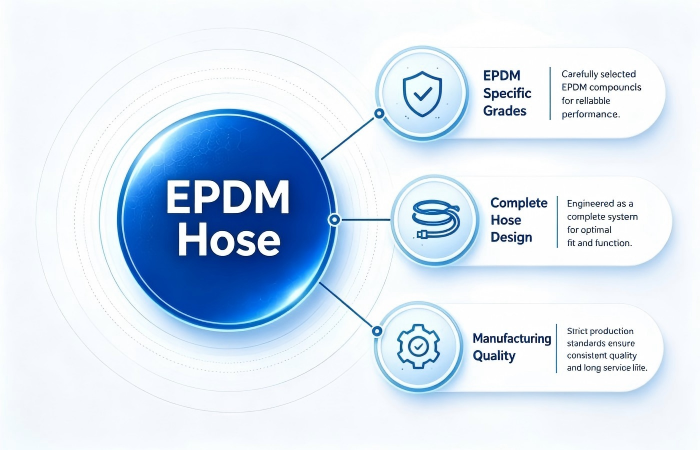
Therefore, when evaluating a hose for a Pre rinse faucet, it is not enough to ask whether it is made of EPDM. The specific EPDM grade, hose construction, and manufacturing quality should also be considered.
Yes. EPDM offers good heat and water resistance and is generally more suitable for hot-water applications than some conventional rubber materials.A Pre rinse faucet hose is often exposed to alternating hot and cold water. If the material does not have sufficient heat resistance, prolonged use may lead to hardening, aging, or even unpleasant odors.EPDM can maintain relatively stable performance at elevated temperatures, which is why it is commonly used in hot-water hose applications.However, not all EPDM hoses are suitable for high-temperature water. The actual operating temperature depends on the specific formulation, hose construction, and rated temperature and pressure.When selecting an EPDM hose, therefore, do not rely on the material name alone. Always check its actual operating specifications.
Pre rinse faucets are commonly used to clean dishes, cookware, and work surfaces. In these applications, the spray valve may frequently be used with hot water.If the hose material is not suitable for the working conditions, the difference may not be noticeable in the short term. However, prolonged exposure to high temperatures combined with repeated bending can continuously increase the stress placed on the material.A well-designed hose should maintain stable flexibility as much as possible, allowing the spray valve to move smoothly during repeated pulling and retraction while reducing the risk of hardening, cracking, and performance loss over time.This is why, although the hose is often hidden inside the faucet assembly, its material can directly affect the user's everyday experience.

When choosing an EPDM hose, do not focus solely on the material name. Consider the following factors:
① Check the Specific Material Grade
“EPDM” only identifies the material category. You should also check the material specifications provided by the supplier, including the intended media and operating temperature range.If the hose is intended for drinking water or direct water contact, verify whether the material has been evaluated for the relevant water-contact application.
② Pay Attention to Odor and Water-Contact Performance
A noticeable rubber odor should not be used as the sole basis for judging material quality. However, if a hose continues to produce a strong odor under normal operating conditions, the material and manufacturing process should be further evaluated.For components that come into contact with water, it is important to consider not only their appearance and feel, but also whether the material could affect the water's odor, taste, or quality.
③ Check Temperature and Pressure Ratings
Do not simply ask whether the hose is made from “heat-resistant EPDM.” Instead, confirm:
· What is the maximum working temperature?
· What is the corresponding working pressure?
· Is it suitable for long-term operation?
Temperature, pressure, and operating time often need to be considered together when determining the actual operating range of a hose.
④ Check Material Sourcing and Manufacturing Quality
Reliable material sourcing and consistent manufacturing processes are equally important.Even when the same type of EPDM is used, differences in raw materials, formulations, vulcanization processes, and quality control can affect the hose's flexibility, heat resistance, and aging resistance.Therefore, when selecting a hose, the material name is only the starting point—not the final consideration.
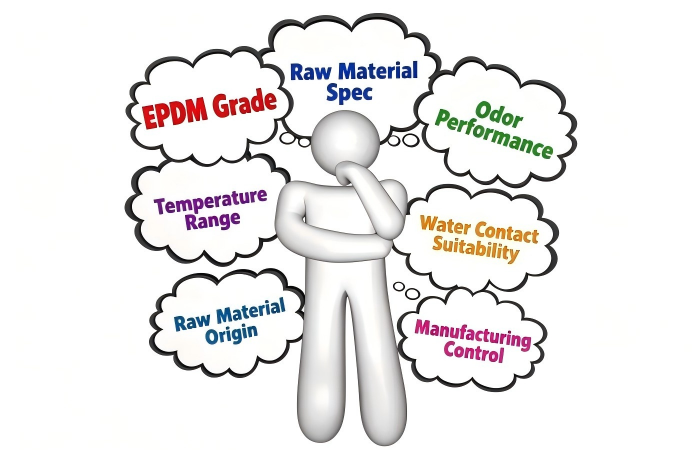
For a Pre rinse faucet, the hose is more than just a component that carries water. It needs to bend, stretch, and retract repeatedly while handling water pressure and changes between hot and cold water.Choosing the right material can help the spray valve move more naturally and maintain flexibility and stability over long-term use.EPDM is well suited to this application because of its combination of water resistance, heat resistance, aging resistance, and flexibility.However, the key consideration is not simply whether a hose is made of “EPDM,” but rather:What grade of EPDM is used? What type of water will it handle? What temperature will it withstand? And under what pressure will it operate?When these factors are properly addressed, a seemingly ordinary hose can become an important part of improving the everyday user experience of a Pre rinse faucet.