
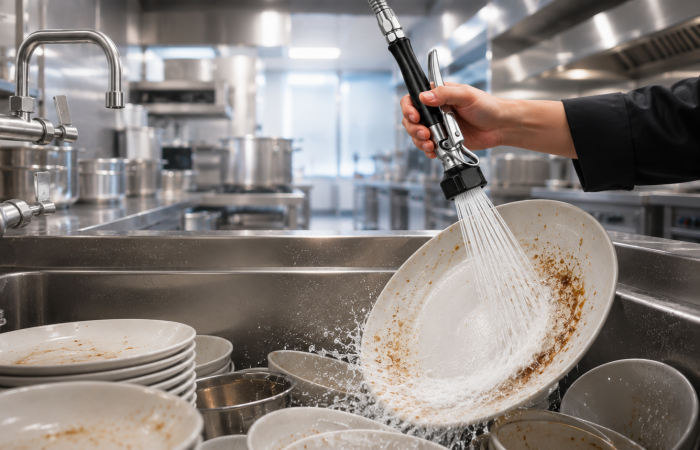
Walk into a restaurant kitchen during peak hours, and you will most likely spot a faucet with a spring-loaded hose and a pull-down spray head at the dishwashing station. It looks like a “water gun” fixed beside the sink. A chef or dishwasher simply pulls down the Spray Valve, aims it at plates, pots, and pans covered in sauce, grease, and food debris, and most of the residue is quickly stripped away.
This piece of equipment is the commercial pre-rinse faucet.
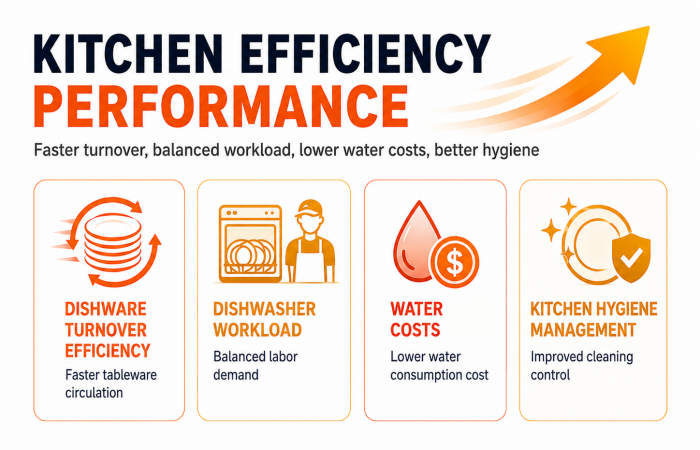
It is not simply an oversized version of a residential faucet. Rather, it is a pre-treatment device within the commercial kitchen washing workflow. For high-frequency cleaning scenarios such as restaurants, hotels, central kitchens, cafeterias, and bakeries, the pre-rinse faucet directly impacts dishware turnover efficiency, dishwasher workload, water costs, and kitchen hygiene management.
“Pre-rinse” refers to the step in which dishware, cookware, and trays receive a concentrated stream of water before entering the commercial dishwasher or formal washing process, to flush away food residue, floating grease, sauces, and some stubborn stains.
Commercial dishwashers excel at high-temperature washing, detergent circulation, and sanitization, but they are not designed to handle large quantities of rice grains, vegetable scraps, bone fragments, batter, or carbonized sauces directly. If dishware is loaded into the dishwasher without pre-rinsing, several problems may arise: filters clog more easily, recirculation water becomes dirty faster, detergent consumption increases, cleaning performance declines, and equipment lifespan may even be affected.
Therefore, the core value of a commercial pre-rinse faucet is not simply “having an extra faucet,” but enabling efficient pre-treatment of dishware before it enters the dishwasher, thereby reducing the burden on downstream cleaning systems.
A regular faucet can deliver water, but that does not mean it is suitable for commercial pre-rinsing.
Commercial kitchen cleaning scenarios have distinct characteristics: large washing volumes, fast pace, heavy grease, high operating frequency, humid working environments, and often continuous use over long periods. Pre-rinse faucets are professional equipment designed specifically around these demands.
First, it improves cleaning efficiency. A high-performance spray valve can flush away surface residue and grease from plates and cookware in a short time, reducing manual scraping and repeated rinsing.
Second, it protects the dishwasher. After pre-rinsing, dishware entering the dishwasher reduces the impact of large debris on filters, spray arms, and recirculation systems.
Third, it helps control water and energy consumption. An excellent pre-rinse faucet does not simply pursue “high flow rate,” but rather optimizes flow rate, rinsing force, and spray angle to achieve stronger cleaning performance within a limited water volume.
Fourth, it enhances the user experience. A retractable hose, return spring, swivel joints, and an ergonomically designed spray valve reduce hand fatigue during extended use and enhance the working experience of staff.
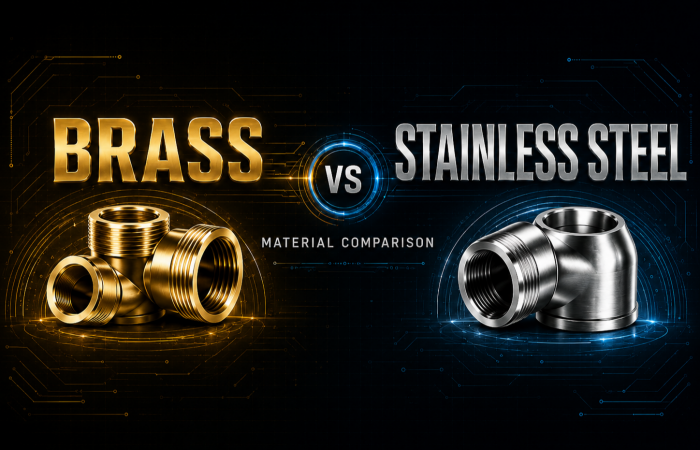
In the selection of commercial pre-rinse faucets, material is a key factor that determines product positioning and service life. Common solutions on the market mainly include brass and stainless steel 304.
Brass products feature mature processing and relatively controllable costs, and are widely used in traditional commercial faucets. However, brass faucets typically rely on surface electroplating for protection and aesthetics. In high-temperature, high-humidity, grease-heavy kitchen environments with frequent contact with cleaning agents, if the plating layer wears down due to long-term friction, impact, or corrosion, subsequent maintenance costs and appearance stability require careful attention. At the same time, when procuring brass products, it is necessary to confirm whether they comply with low-lead or lead-free requirements in the target market.
In contrast, stainless steel 304 is more suitable for commercial kitchen scenarios with higher demands for food safety, corrosion resistance, and long-term durability.
Stainless steel 304 is widely used in food processing equipment, kitchen equipment, and commercial kitchen facilities. Its surface does not require electroplating, so there is no risk of plating peeling or flaking that would affect appearance and hygiene. For kitchen environments with long-term exposure to water vapor, salt, acidic residues, and cleaning agents, stainless steel offers clear advantages in corrosion resistance, structural strength, and maintenance convenience.
BESTWARE has long been focusing on the field of stainless steel commercial faucets and was the first to achieve mass production of commercial stainless steel faucets in 2015. For customers pursuing long-term durability, food-grade safety, and stable quality, stainless steel 304 is not merely a marketing concept, but a material choice that better aligns with the logic of long-term use in commercial kitchens.
A pre-rinse faucet truly suitable for commercial kitchens cannot be judged by appearance alone. More importantly, one must evaluate spray valve performance, flow control, hose structure, cartridge lifespan, and installation adaptability.
The spray valve is the heart of the pre-rinse faucet. It achieves effective rinsing through nozzle structure and water flow path design.
When facing different types of stains, traditional spray valves often lack flexibility. For example, removing carbonized sauce from a baking tray requires a more concentrated, powerful stream, while dealing with floating grease and light soiling on a large number of plates calls for a wider coverage pattern. Traditional pre-rinse spray valves typically offer only a single spray mode. When a nozzle change is needed, the operation is cumbersome and small parts are easily lost, creating operational inconvenience.
To address this pain point, BESTWARE independently developed a patented dual-function spray valve. Users simply rotate the spray head to flexibly switch between two spray modes: power rinse mode and wide-area rinse mode.
• Power Rinse Mode: Suitable for tackling stubborn residue, dried rice grains, carbonized sauces, and stains in corners of cookware. The water stream is more concentrated, enabling targeted cleaning.
• Wide-Area Rinse Mode: Suitable for quickly rinsing plates, trays, and cookware surfaces of floating grease and light soiling. The coverage area is wider, improving overall efficiency during the pre-wash stage.
This dual-function design allows commercial kitchen staff to adjust the spray pattern quickly based on the actual cleaning target, without changing nozzles or using additional tools, balancing both cleaning power and operational efficiency.
When evaluating pre-rinse faucet performance, many people focus only on flow rate-liters per minute. But in commercial kitchens, what truly matters is “effective rinsing capability,” not simply high water volume.
Excessive flow rate not only wastes water but also increases hot water energy consumption and causes splashing. Insufficient flow rate and rinsing force, on the other hand, prolong rinsing time and reduce efficiency. Therefore, excellent products must strike a balance between flow rate, rinsing force, nozzle angle, and water coverage. For export or project procurement, one should not rely solely on a single flow rate figure on a brochure, but also consider target market regulations, test conditions, actual data, and flow-pressure curves.
For buyers, contractors, and brand customers, it is recommended to request flow test data, pressure test data, and relevant certification documents from suppliers during selection. This is more reliable than simply looking at marketing terms like “high pressure” or “water saving.” BESTWARE provides flow curve charts on the product detail page of every pre-rinse faucet for customer reference (taking our patented dual-function spray valve as an example, please visit https://www.bestware-stainless.com/Products/Spray-Valves/Dual-function for details).
A key reason pre-rinse faucets are well-suited to commercial kitchens is their retractable structure. The spring-loaded hose allows the spray valve to reach different corners of the sink and accommodate baking trays, deep pots, and large containers that are not easily moved.
However, the hose is also a high-wear component. If the structural design is unreasonable, prolonged stretching, bending, and rotation can lead to leaks, deformation, poor spring return, or loose fittings.
BESTWARE employs a higher-specification engineering solution for hose construction. The inner tube uses high-temperature, high-pressure resistant EPDM material, while the outer wall is paired with a stainless steel structure, balancing flexibility and durability. Both ends of the hose are equipped with 360° swivel joints and universal ball joints, effectively absorbing torsional stress during use and reducing hose damage caused by over-bending.
The external stainless steel spring offers excellent corrosion resistance and support, with a tensile load capacity of up to 155 kg, capable of withstanding frequent stretching and high-intensity use in commercial kitchens. The inner EPDM tubing can withstand temperatures up to 95°C, maintaining stable water supply even in high-temperature hot water environments.
Particularly noteworthy is that BESTWARE’s universal ball joint structure has passed over 200,000 rotation cycle tests, significantly improving the durability of the hose connection area and thereby extending the overall service life of the pre-rinse faucet assembly.
The cartridge is the core component that controls on/off operation and hot/cold water mixing. Unlike residential kitchens, a commercial pre-rinse faucet may undergo a large number of on/off operations daily, so cartridge lifespan directly affects product stability and maintenance frequency.
High-quality commercial pre-rinse faucets typically employ cartridges with better wear resistance, pressure resistance, and sealing performance, with switch lifespans reaching the 200,000-cycle level. For high-frequency use scenarios such as restaurants, hotels, and central kitchens, cartridge stability not only affects operating feel but also relates to leak risk, repair frequency, and overall cost of ownership. BESTWARE has developed four different cartridge options for its pre-rinse faucets to meet diverse needs (for details, please visit the pre-rinse faucet main page at
https://www.bestware-stainless.com/Products/Pre-Rinse-Faucets).
Material. Prioritize 304 stainless steel for the main body, especially for projects with high requirements for food safety, corrosion resistance, and long-term durability.
Spray valve. Confirm whether it delivers sufficient rinsing force, supports different spray modes, and allows kitchen staff to switch quickly.
Flow data. Do not rely solely on marketing terms like “high pressure” or “water saving.” Pay attention to actual flow performance under different water pressures, as well as regulatory requirements in the target market.
Hose structure. Focus on hose material, temperature resistance, swivel joints, universal ball joints, spring return, and tensile strength.
Cartridge lifespan. Commercial scenarios involve high on/off frequency, so cartridge durability and sealing stability must meet long-term, high-frequency use demands.
Supply capability. For distributors, contractors, and brand customers, stable supply, customization capability, test documentation, after-sales parts, and technical support are equally important.
A commercial pre-rinse faucet may seem like a small piece of equipment beside the kitchen sink, but it involves materials science, fluid design, structural engineering, and ergonomics. It serves as the first efficiency checkpoint in the dishwashing workflow.
For commercial kitchens, an excellent pre-rinse faucet can reduce residue entering the dishwasher, improve cleaning efficiency, lower water and maintenance costs, and enhance the experience of staff during long hours of operation. For distributors, contractors, and brand customers, choosing stable, durable products that meet food-grade application requirements also means lower after-sales risk and higher customer satisfaction.
BESTWARE, with stainless steel 304 commercial faucets as its core focus, combines independently developed dual-function spray valves, high-durability hose structures, 360° swivel connection solutions, and mature R&D, production, and sales integration capabilities to provide more flexible and reliable pre-rinse solutions for different types of commercial kitchens.
From material to structure, from function to service, BESTWARE aims to make every selection more reassuring and every kitchen more efficient.